





Bumdra Trek
Hike the Bhutan mountains in two days

-

Bumdra Monastery
... -
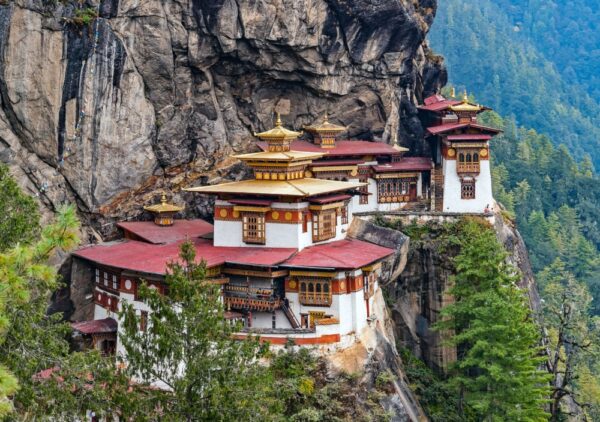
Taktsang Monastery (Tiger's Nest)
...
Of all the major Bhutan treks, the Bumdra Trek is the easiest and is the one I recommend for visitors who want a taste of hiking in Bhutan's mountains without undertaking a major multi-day expedition. It’s short (just two days) but still delivers a proper high-altitude experience, with forest trails, ridge line views and a memorable night camping near 3,800m.
The trek usually starts with a short drive from Paro to the Sang Choekor Buddhist College, perched on the hillside above the valley. From there, it’s a steady uphill hike through pine and rhododendron forest, climbing around 1,000m over the course of eight to nine km. It’s a decent ascent – enough to get the lungs working – but manageable for anyone reasonably active with some hiking experience.
The camp at Bumdra sits just below the ridge, with big views back over the Paro Valley and, on a clear day, distant Himalayan peaks on the horizon. I’ve woken here to mist rising off the valley floor and watched the sun catch the mountain tops at first light. If you’re feeling up to it, there’s a short hike beyond the camp to a higher viewpoint – a small effort for more expansive views.
The second day is longer in distance but easier going. The route descends 13 to 14 km towards Taktsang (Tiger’s Nest) Monastery. Coming in from above gives you a far quieter and more scenic approach than the regular day-hike. With an early start, you can often reach the site before the main crowds arrive, when the courtyards are still calm and the cliffs are catching the first light.
Good to know
- Difficulty: Mild-moderate
- Duration: Two days
- Distance: Approx. 23km
- Start/end point: Sang Choekor to Taktsang Monastery
Key information
| Destinations | Bhutan |
|---|---|
| Activity | Adventure, Trekking, Active, Walking, Nature & Wildlife, Culture, Responsible Travel, Slow Travel |
| Physical Level | Moderate |
 Season Season |
April - November |
Featured tours

Culture of Bhutan with the Bumdra Trek
Small group culture & hiking tour of Bhutan
7 daysFrom $2,360Featured tours
 Bhutan
Culture of Bhutan with the Bumdra Trek
Small group culture & hiking tour of Bhutan
7 days From $2,360 ppBumdra Trek itinerary

Sang Choekor to Bumdra Monastery
Day 1 in Bumdra Monastery
The route begins near Paro at the Sang Choekor Buddhist College, situated at approximately 2,800 metres. If time allows, it is customary to receive a brief blessing from resident monks before setting off, something often done by local pilgrims before embarking on treks of spiritual significance.
From Sang Choekor, the trail climbs steadily through pine and rhododendron forest, gaining elevation as it winds toward the ridgeline. Along the way, a short detour leads to Chhoe Tse Lhakang, a remote shrine perched above the valley. From this vantage point, expansive views open up over Paro and, on a clear day, to the distant snow-covered peaks of the eastern Himalayas.
The final stretch follows a series of undulating ridges strung with prayer flags, gradually revealing the high pastures where Bumdra Monastery sits. Located at around 3,800 metres, the monastery, whose name translates as “Cave of a Hundred Thousand Prayers,” is perched dramatically on the cliffs and offers far-reaching views in all directions. Camp is typically set up on a nearby meadow, allowing time in the late afternoon to visit the monastery, explore the surrounding terrain, or simply rest.
Overnight: Tent camping near Bumdra Monastery. Conditions are basic but atmospheric. Skies at this altitude are usually clear, making it a good place for stargazing.

Bumdra Monastery to Tiger's Nest
Day 2 in Taktsang Monastery (Tiger's Nest)
The morning begins with a descent through high alpine meadows, eventually merging into dense forest as the trail drops in altitude. The route contours the mountainside before linking up with the main path to Taktsang Monastery (Tiger’s Nest).
Emerging suddenly on a ledge opposite the monastery, the viewpoint offers one of the most iconic sights in Bhutan. Clinging to the cliff face at 3,120 metres, Taktsang is a key pilgrimage site in Bhutanese Buddhism. According to tradition, Guru Rinpoche is said to have flown to the site on the back of a tigress in the 8th century and meditated there in a cave, now enshrined within the temple complex.
Allow time to explore the monastery, noting that photography is not permitted inside. The final descent continues down a steep, wooded path to the valley floor. From there, transport is typically arranged back to Paro.
Need to know
The Bumdra Trek isn't a multi-day expedition trek, but it’s a good option if you’re short on time. You still get the feel of trekking in Bhutan – the mountain air, the prayer flags, the forest trails – but without the days of back-to-back walking or the higher levels of fitness required elsewhere. It makes for a great warm-up and acclimatisation trip for Bhutan's longer treks, such as the Druk Path, Dagala Thousand Lakes trek, or Jomolhari if you're feeling more adventurous.
Logistics
Accommodation is camping – basic but well-organised. You’ll sleep in tents, with meals prepared by the crew. Food is usually a mix of Bhutanese, Indian and Western dishes, and you might get to try a cup of suja (butter tea) or ema datshi, the national chilli-cheese stew. The trek must be booked through a licensed Bhutanese operator, who will arrange guides, meals, tents, and permits. Most packages are fully inclusive – you just need to bring your own gear: sturdy boots, warm layers, a rain jacket, sun protection, and any personal medication.
When to go
Spring (April-May) and autumn (late September-November) offer the most stable weather and clearest views. Even outside winter, nights at the campsite can be cold, so warm gear is essential. Spend a night or two in Paro before starting – the altitude at Bumdra is real, and a bit of acclimatisation helps.
Other itineraries you might like

Classic Everest Base Camp route
16 day Everest Base Camp trek itinerary
Approx. 16 days
Upper Mustang trek to the Walled City
A trek through Nepal’s restricted Tibetan side
Approx. 14 days
Helambu & Langtang Trek
Crowd-free trekking on Kathmandu’s doorstep
Approx. 16 days

Golden Triangle & Andaman Islands Itinerary
Desert island beaches and Royal Bengal tigers
Approx. 11 days
Find a Bhutan specialist
Tell us about your trip and we'll find your match
We'll connect you directly with the experts.



We'll connect you directly with the experts.
- Hand-picked local specialists
- Honest advice from real experts
- Free to use, no hidden fees