







Problems afoot on the Inca Trail
Money and power on Peru's most famous trek

The first person I interviewed for this article met me in a noisy cevichería in Cusco, the historic Inca capital and epicentre of Peru’s booming tourism industry. As soon as we sat down, she asked me: “Can I be anonymous?”
“María” has been a trekking guide on the Inca Trail for nine years. She talked for hours about her experiences. I took notes, since she asked that I not record her voice. This wasn’t surprising: María was risking her livelihood by talking about the problems behind one of Peru’s biggest tourism successes.
For lots of travellers, hiking the 43 kilometre Inca Trail is the highlight of their trip to Peru. Regularly featured in round-ups of the world’s greatest treks, the four-day hike follows a section of original Inca path as it weaves through the Andes past a string of archeological sites before reaching Machu Picchu.
But few visitors see the murky reality behind Peru’s most famous trek, or hear about the tensions over workers’ rights that echo centuries-old inequalities between indigenous communities and outsiders.
“Some trekkers are interested in how much the porters are paid, how heavy their packs are, what they eat, where they sleep... But it’s hard to answer those questions,” María told me. “Some trekking agencies send good food for the porters, but they don’t always have time to cook. Sometimes there isn’t enough cooking gas for them.”
“We still have a colonial system here,” María went on. “Porters are expected to be submissive, and they’re afraid to complain in case they lose their jobs. I tell our porters to tell people the truth about the weight they carry and the food they are given, but there’s too much fear.”
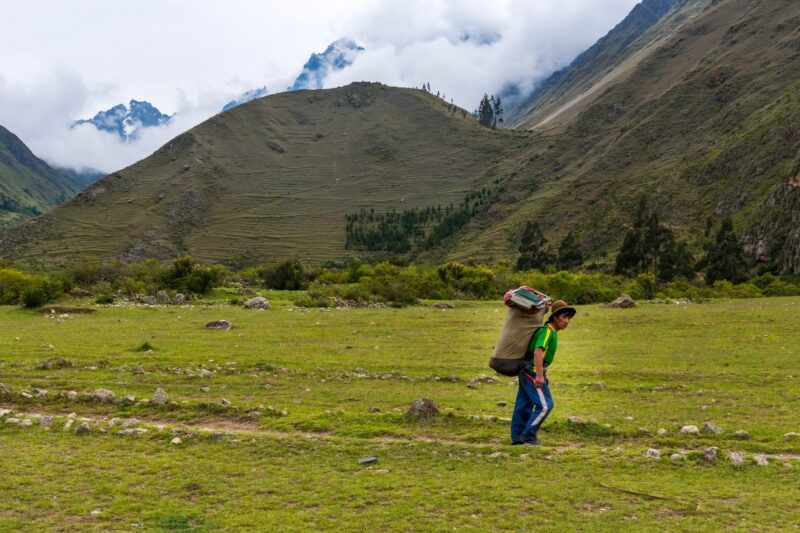
A porter carrying a heavy pack on the Inca Trail, Peru
Credit: Tiago FernandesPaved in places with stone laid by Inca engineers in the 15th century, the trail itself is an important and carefully-conserved archeological monument.
The mules and horses used on Peru’s other commercial treks would quickly destroy the delicate footpath (even metal-tipped walking poles are prohibited) and so everything required to support some 200 trekkers per day must be carried on foot by porters. And, at a maximum elevation of 4,215 metres (13,828 ft) above sea level, this is no small feat.
While tourists struggle under the weight of their daypacks, their porters race ahead carrying vast bundles on their backs. Old style canvas tents, tables and chairs. A whole kitchen’s worth of pots, pans, plates, bowls, cups and cooking utensils, plus enough fresh ingredients and metal gas canisters to prepare three gourmet meals a day. It’s more than most people would load into their car for a camping trip.
On the trail itself, you cannot fail to be amazed when a team of porters rushes past at twice your speed, a 25 kilogram (at least) load on their backs, in time for your tent to be ready and a mug of hot coffee waiting for your arrival. Some trekking agencies portray their porters as machines, suggesting that these daily feats of superhuman strength are an intrinsic part of Andean culture and physique. But is it true?
In actual fact, porters are bound by the limits of human biology like the rest of us. In 2001 the government cracked down on the worst exploitation by introducing a 20kg weight restriction per porter, plus 5kg for personal gear – which includes their own sleeping equipment. Later modifications to the law also improved wages and mandated that porters be given insurance, nutritious food, water, and a dry place to sleep.
But there are many ways that trekking operators get around the law and overburden their porters, according to Miguel Góngora of Evolution Treks, one of the few trekking operators who seems alive to the scale of the problem.
“Tour companies generate millions in revenue through unethical practices such as underpaying salaries and exceeding legal weight limits for porters,” Góngora told me.
“Porters are often paid less than the legal minimum wage, and they’re expected to carry more weight than legally allowed without additional compensation. These practices allow tour companies to maximise profits at the expense of their workers' well-being and fair compensation.”
In a country that is sadly afflicted by corruption at virtually every level, enforcement of workers’ rights is patchy at best. “There was an undercover inspector on one of my trips,” María told me. “He saw everything but then vanished.” María never saw a report of what she knew the inspector had seen, and never heard a word spoken of the inspection.
José, who has worked on the Inca Trail since 2007, was the only porter who would agree to talk to me for this article – and only on condition of anonymity. “We’re still exploited,” he told me. “We carry 35 kilo packs and recieve plain pasta to eat. There’s no protein in our meals. We work from 5am to 10pm and don’t have a dry place to sleep most of the time.”
Further hindering progress are the constantly shifting sands of the laws governing workers’ rights on the Inca Trail. New legislation was passed in 2022, modified by congress in 2023 and again in April 2024, before being thrown out entirely by a judge in May 2024.
The largely Quechua-speaking porters rely on the Regional Federation of Porters to interpret the constantly changing legalese, but the system is stacked against them – as it has been since colonial times. Most politicians and company owners are from Lima and have Spanish surnames, while most workers are from rural areas and have Quechua names.
Meanwhile, Peru’s tourism industry – worth a pre-pandemic $4.7 billion – continues to boom, generating vast profits for Lima and internationally-based corporations. In a way, the story of power and money on the Inca Trail is the story of power and money in post-Columbian Peru.
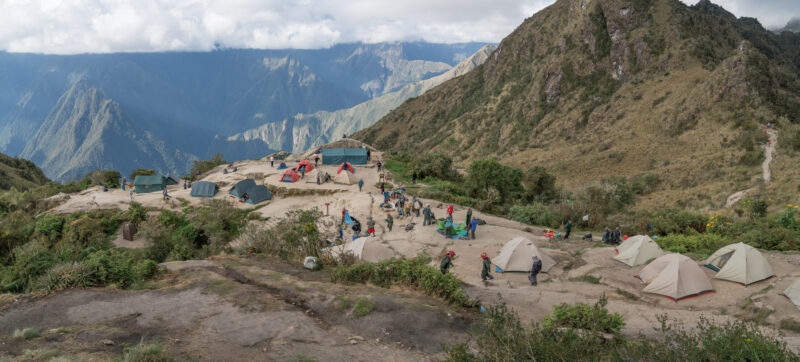
A campsite on the Inca Trail. Everything you can see was carried in by porters
Credit: Stephen WoodDespite sluggish but growing awareness among travellers and the best efforts of Peru’s responsible trekking agencies, abuses and exploitation persist. Even today it’s not uncommon to see porters sleeping in dining tents on the cold ground, or heaving oversized packs with inadequate shoulder straps or waist belts.
“It doesn’t feel like work because I enjoy it so much,” says Dolores, another guide who asked to remain anonymous. Dolores has been guiding on the Inca Trail for eighteen years. “But not everything is rosy. We’re not a perfect tourist destination.”
With the industry dragging its feet, ultimate responsibility lies with us – the visitors. “The biggest problem is silence,” says Miguel Góngora. “It’s time for every traveller to question trekking companies, and to keep their eyes open when they’re on the trail.”
“Write this down,” José said, pointing to my notebook. He spoke slowly, making sure I wrote every word. “Tell your readers what it’s like to work on the Inca Trail. Tell them that there’s no clean water to drink and nowhere for us to sleep at the last campsite. Porters work out of necessity and companies take advantage of us because of it. The government doesn’t listen to us. Nobody in Peru is fighting for us. We need your help to change the system.”
How to spot a responsible Inca Trail trekking operator
Some key questions to ask or look out for before you book:
How much are the porters paid? The minimum wage is s/350 Peruvian soles (around USD $94) for four days' work.
Ask about the porters’ working conditions. What are their backpacks like? How much does each porter carry? Where do they sleep? What do they eat?
Will you sleep in lightweight tents that are designed for trekking? Is the dining tent lightweight? Are porters carrying tables and chairs?
Most importantly, when you ask about these details, is the trekking agency evasive and cagey? Look for a company that is clear and direct about the porters’ working conditions. Even just asking the right questions can help shift attitudes.
Avoid treks marketed with frivolous extras: fresh salads, extravagant food, inflatable sleeping mattresses, and so on. Remember, porters are paid to carry things for us… but only within reason.
Or, take a look at any of the alternatives to the Inca Trail, none of which depend on porters for equipment transport.

About the author
Heather Jasper
Based in Cusco, Peru, Heather is an expert on travel to Peru and South America. Heather writes on tourism, trekking, and social issues in Peru for publications including BBC Travel, Fodor’s Travel, Matador Network, Thrifty Nomads, World Nomads, Frommer's, Flashpack, and more. Heather co-founded the Covid Relief Project with Henry Quintano Loaiza to assist vulnerable families in the Cusco region.