




Selling paradise: Maldives beyond the resorts
Life and travel on the Maldives’ local islands

The public ferry from Malé to Himmafushi is a relaxed trip. Ninety minutes of open water, diesel hum, salt on the air. I was sitting on the roof deck the first time I made the crossing, shoes kicked off, the breeze carrying bursts of laughter and conversation as people settled in for the ride. Just a normal day in the Maldives: Families heading home, shoppers returning from the capital, neighbours catching up as the islands slipped past.
Before we’d even cleared the harbour, someone had asked where I was going. Then someone else. By the halfway point I’d picked up a few Dhivehi words, learned who was related to whom, and been subject to a half-joking proposal that I marry one of their sons.
It was the sort of warm, disarming, deeply human encounter that makes you instantly fall in love with a place.
It's also exactly the sort of thing most visitors to the Maldives never get to experience.
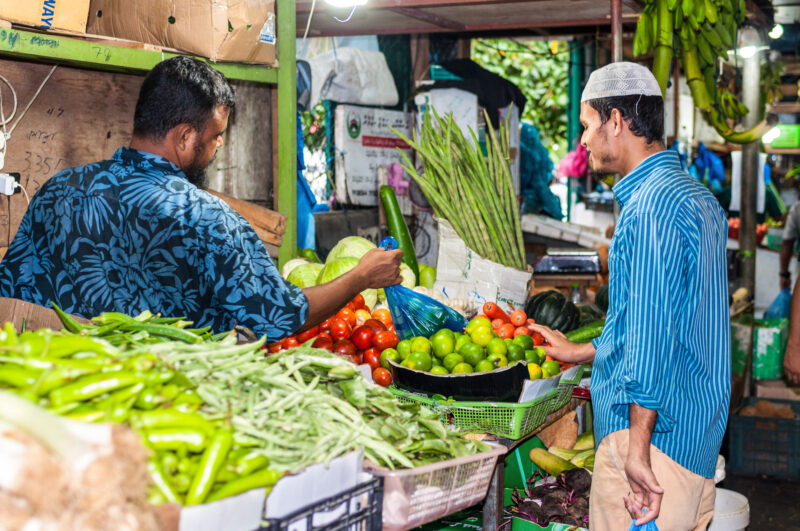
A market on Malé – a slice of everyday life most tourists never see
The Maldives most visitors never see
If you’re aware of the Maldives, chances are it’s through the prism of glossy "destination marketing" which has done a great job of pushing a singular model of super high-end tourism with uber exclusive resorts on their own private islands.
In 2024, tourism brought around $5.6 billion into the Maldivian economy, with over 83% generated by high-end resort style tourism. Many resorts are foreign owned by international brands, rely heavily on imported goods, and employ large numbers of expatriate workers. This means a significant share of tourism earnings simply leaves the country.
Local-island tourism operates on a different model. When you visit local islands and stay in locally owned guesthouses, eat in island cafés, use public ferries, hire local guides, shop in neighbourhood markets and purchase locally-made souvenirs, more of your vacation money stays within the immediate economy.
Of course, not every guesthouse is locally owned, and not every role is filled by Maldivians but still, the economic connection is immediate and visible.
Ironically, it’s the lower spending visitors who contribute more directly to the local economy than the so-called “high value” tourists.
And if you ask me, this ordinary Maldives is just as rewarding a place to visit. You move through inhabited places: villages and communities, where Maldivians live and work. Boats come and go, shops open and close around prayer times, children walk between home and school, construction happens, everyday life unfolds around you.
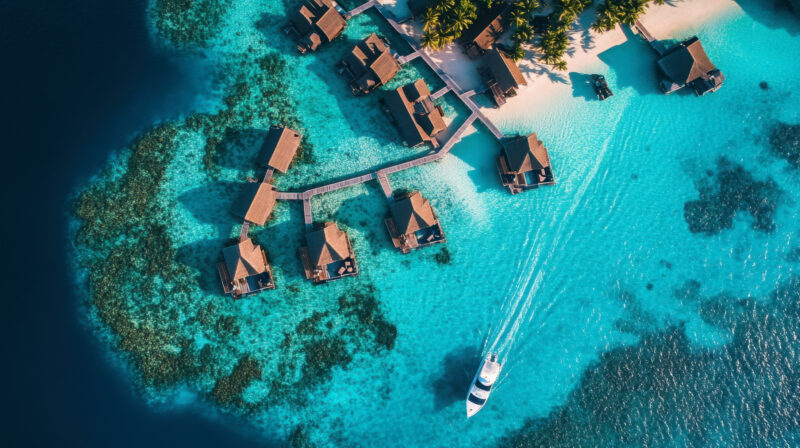
A vision of the Maldives pushed by international tourism with not a local in sight
Locally-based tourism in the Maldives
The main difference between the local and resort experiences is that instead of being isolated in one hermetically sealed spot for the entire trip, you have the freedom to move: hop from island to island, or stay on one and explore local life in greater depth.
You travel by public ferry and local boats, sitting next to Maldivians going about their day; families visiting loved ones, or returning from a shopping visit to the capital. You learn the schedules, the systems, and geography of the country – not as a string of isolated dots, but as a real place where real people live.
Of course, because it’s the Maldives, time in (and on) the water is still central. You’ll snorkel and kayak around reefs and sandbanks that matter to the people who live nearby. Being in these waters offers a real sense of how the ocean and local communities are connected and why these places are worth noticing and protecting.
On land you’ll walk through villages, visit mosques, small businesses and community projects, talking to people working on conservation or climate change mitigation. The best moments are the serendipitous encounters, brief connections, or simply just sitting outside while neighbours drift past and conversations overlap in the evening breeze.
These moments don’t sell well in marketing photographs; you can’t bottle them up into a neatly packaged tourism commodity. They are, however, the ones that people talk about long after they’ve forgotten which overwater villa they stayed in.
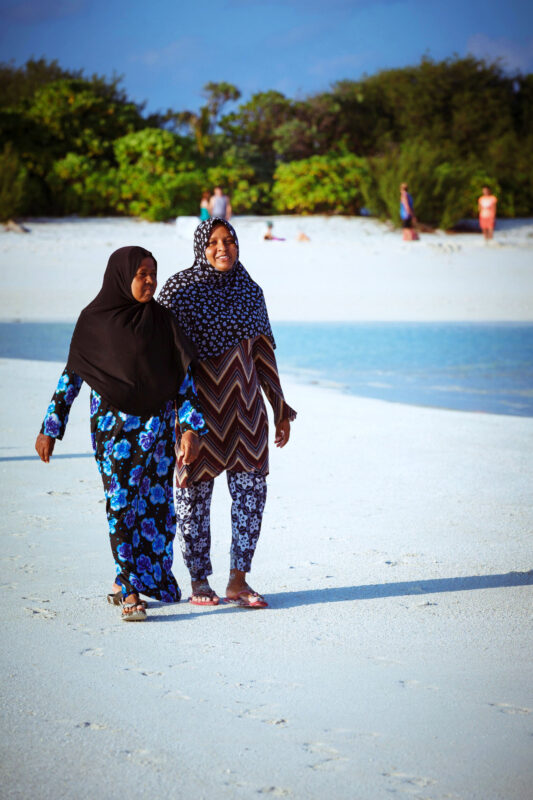
Local beach in Fulidhoo, the Maldives
This model of local tourism isn’t for everyone. The Maldives is a Muslim country: alcohol isn’t available on local islands, Western swimwear is limited to designated bikini beaches. Evenings are calm, not lightlife oriented. Life follows its own rhythms – the universe doesn’t bend to your needs as a tourist, you adapt to the community and culture you’re visiting.
Comfort exists, but it’s practical rather than indulgent. You won’t find private pools, spas on demand, or perfectly frictionless days… Boats run late, the weather turns, plans change. For some people, that’s a compromise too far. For many, it’s precisely what makes the experience feel real and worthwhile.
Increasingly, people choose to combine a local island stop before or after a resort stay. They enjoy both, but when I catch up with them later, it’s usually the days on the local island they describe as most memorable.
I don’t see this way of visiting the Maldives as “better” than any other, it’s not about replacing anything, more about adding a new layer. Even a few days on the local islands can provide a deeper sense of the country and its people. You still leave with memories of turquoise water and white sand. But you also leave knowing where you were, who you met, and how your visit fitted into everyday life.
Hajja, who runs a guesthouse and the Fins Dive school on Rasdhoo island, said it best: “My favourite moment is seeing their reaction when they try real Maldivian food,” she told me with obvious pride.
“To see their enjoyment encourages me to continue to do it and keep sharing my culture with them,” she adds.
In travel, food is never just about the food itself, it's about the personal connection and real cultural encounters between people. I asked what she thought the most important aspect of tourism was for her. “It's the time we spend with them,” she replied with no hesitation.
About the author
Ruth Franklin
Ruth is co-founder of Secret Paradise Maldives. She has been working in local tourism to the Maldives for over 20 years.