





The best Mount Kenya route
The best route up Kenya's highest peak

-
Nanyuki
... -
Chogoria Gate
... -
Lake Ellis
... -
Lake Michaelson
... -
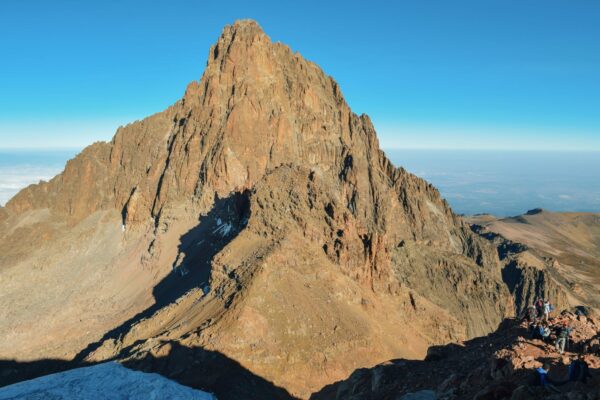
Mount Kenya
Mount Kenya might only be Africa’s second-highest mountain, but it’s considerably more beautiful than it’s bigger cousin, Kilimanjaro... -
Sirimon Gate
...
The vast majority of visitors on a Kenya safari fly in, zoom around the Masai Mara and the other big name parks, and then jet off home again. For people looking for another side to Kenya, taking a few days to climb its highest mountain (and Africa’s second highest after Tanzania’s Kilimanjaro), is top of my list of recommendations.
In the league of mountain peaks, Mt Kenya’s Point Lenana at 4,985 metres is only a few hundred metres below Everest Base Camp and 900 metres below Uhuru Peak on Kilimanjaro. So it’s up there with the giants! Climbing Mount Kenya is ideal for experienced walkers looking for something to do in Kenya other than a safari and who don’t mind some hardships – expect cold nights and no showers for a few days.
I climbed to Point Lenana on Mount Kenya for the 11th time this year. I should mention that I’m in my 60s and averagely fit. But knowing the mountain so well means the mental challenge is manageable, and I rely on my brain’s muscle memory to cope with the physical challenge.
As with Kilimanjaro there are several routes up the mountain, of varying difficulty and popularity. The Sirimon route is the easiest ascent as it is the most gradual and the terrain is easier to navigate. Naro Moru is the most easily-accessed and therefore most commonly marketed, but this is one I avoid as the ascent and descent are both very challenging – the area known as the "Vertical Bog" which, depending on how much rain there has been, can be as bad as it sounds!
My favourite way to climb Mt Kenya is to go up via the scenic Chogoria route and back down via the Sirimon route. You won’t find this route offered by most commercial operators but it’s off the beaten track and walking on the eastern side of the mountain above the spectacular Gorges Valley and staying at Lake Michaelson is by far the best scenery. This is also the best Mt Kenya route for camping, as the ground is grassy and reasonably soft near the lakes, where there’s also easy access to water.
Key information
| Destinations | Mount Kenya |
|---|---|
| Activity | Adventure, Trekking, Active, Walking, Camping, Nature & Wildlife |
| Physical Level | Strenuous |
 Season Season |
June - February |
Featured tours

Featured tours

The best Mount Kenya route itinerary

Nairobi to Nanyuki (drive)
Day 1 in Nanyuki
You can drive from Nairobi or fly north from Nairobi (Wilson Airport) to Nanyuki. Stay overnight near Nanyuki airstrip. I recommend Soames Hotel (B&B), a lovely small hotel, conveniently located just outside Nanyuki town.
You have the afternoon to rest and acclimatise.

Nanyuki to Chogoria Bandas (drive)
Day 2 in Chogoria Gate
Drive from Nanyuki to Chogoria via the Meru bypass, which takes about 2.5 hours, there’s a coffee stop opportunity on the way.
On arrival in Chogoria, drive to the lower Park Gate where your e-ticket will be registered, and you’ll need to show your passport/eTA to the KWS (Kenya Wildlife Service).
You then continue up to the Chogoria Gate proper and to the Chogoria Bandas (simple accommodation near the gate) where you’ll stay overnight. The transfer from Chogoria town takes about 1.5 hours and covers 32 km, including 22 km up a steep track through the forest.
On arrival, you have a late lunch followed by a gentle stroll around the Bandas. You have your own room with a private bathroom, and hot showers are available in the early evening. Supper is served in front of a log fire in your sitting room. Wifi is available in the bar/restaurant area.

Chogoria Bandas to Lake Ellis
Day 3 in Lake Ellis
After breakfast, the hike begins as you set off along the Chogoria route towards the conical Mugi Hill. Then you turn off the main route and walk to Lake Ellis at 3,405 m, where you camp overnight. This walk takes four hours and covers eight km, including a detour to the Nithi waterfalls for a picnic lunch.

Lake Ellis to Lake Michaelson
Day 4 in Lake Michaelson
You walk to Lake Michaelson at 3,900 m, and camp overnight.
This walk is eight km and takes about six hours as you are now climbing steadily, although the last section of the walk is a steep descent down to the lake.
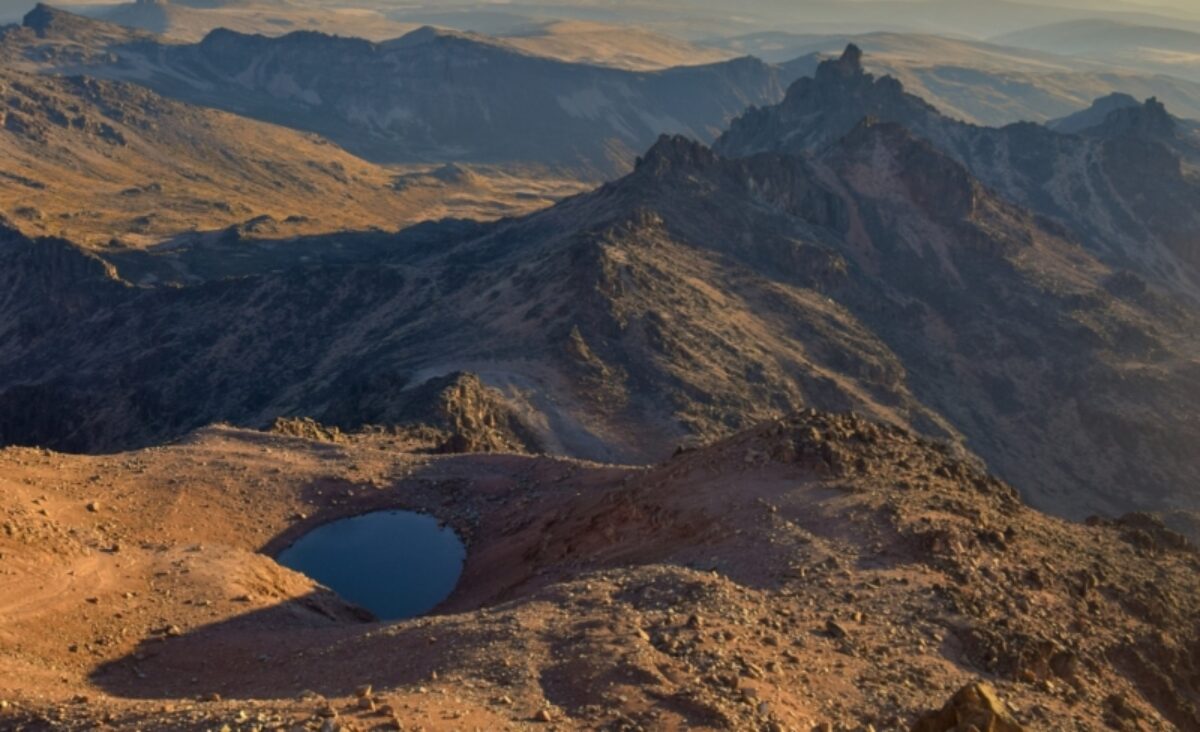
Point Lenana ascent and back down
Day 5 in Mount Kenya
You make an early start at around 5.00 a.m. to give you the best chance of good weather and with the aim of reaching Point Lenana at 4,985 m by 9.00-10.00 a.m. After about half an hour at the summit, you descend to Shipton’s Camp where you have brunch and then it’s about an hour’s walk down to camp, where you spend the night.
Today you cover eight km and the total walking time is about 7-8 hours.

Return to Sirimon Gate
Day 6 in Sirimon Gate
After breakfast, you walk down to Old Moses Camp arriving around noon. This walk covers 11 km and takes about four hours. Rather than spending another night camping at Old Moses Camp, I usually suggest transferring directly back to Nanyuki, via the Sirimon Gate, so you can get a well-earned bed and much needed shower.
Climbing Mt Kenya: need to know
Mt Kenya routes
Note that the Chogoria route is the most inaccessible – it’s a long drive to the gate compared to Sirimon and Naro Maro – but that’s what makes it so quiet, so well worth it in my opinion.
There are also the Timau, Burguret and Kamweti routes but these are not much used as there are no gates to enter the National Park on these routes.
For safety reasons, it’s not permitted to climb Mt Kenya without a guide unless you’re just walking for a few hours near a gate.
It is freezing at night and being prepared with the right kit is hugely important. My most important evening ritual is getting a covered hot water bottle into my sleeping bag ASAP. I’ve also experimented with a double sleeping bag setup: you put your sleeping bag into an even bigger one – I road tested this idea at a campsite up at 4,600 metres and I was warm as toast!
If you don’t want to climb Mt Kenya
If you don’t feel capable of the full Mt Kenya ascent, there are some lovely hiking trails through forested parkland to the Nithi Falls and Lake Ellis. I like to camp on the shores of Lake Ellis from where you can make a dawn ascent of Mugi Hill. From here you can watch the sun rise, serenaded by the dawn chorus, light catching on Mt Kenya’s peaks. It’s magical, and a much easier walk for all abilities.
When to climb Mt Kenya
I would avoid the rainy seasons - particularly the long rains – from mid-March through to mid-May. During this time, the weather can be unpredictable – chances are you’ll have rain, hail, snow and cloudy conditions with no views! Mount Kenya can be busy during peak season periods, but you generally see very few people on the Chogoria side and more on the Sirimon and Naro Moru side.
Other itineraries you might like
Western Uganda
Mountain gorillas and beyond
Approx. 10 days
Eastern Uganda
Nomads, Nile and natural pools
Approx. 7 days
Tanzania safari and beach
See all the spectacular wildlife Africa has to offer
Approx. 11 days
Kilimanjaro and Tanzania wildlife adventure
Explore snow-capped Kilimanjaro and tour wild game reserves
Approx. 14 days
Unexplored Tanzania
Off the beaten path safari and beach escape
Approx. 15 days