36 picksPlaces & Experiences You Won't Find Elsewhere
Where
What
Quark Expedition's Ultramarine is the ship I point to when someone says, “I want to do everything.” It’s perfect for intrepid explorers seeking activity-heavy itineraries and in-depth Arctic exploration. As well as its zodiacs, kayaks, and stand-up paddleboards, her two twin-engine Airbus H145 helicopters open up a whole other dimension of possible polar pursuits that’s unrivaled elsewhere—not only do these facilitate “flightseeing”, providing unique aerial perspectives of the Arctic realm, but they also allow you to participate in adventure activities in remote destinations only accessible by air; think heli-hiking in the Canadian High Arctic, or Alpine kayaking, camping, or ice sheet experiences in Greenland.
Operationally, it’s one of the most versatile vessels there is, giving expedition teams a huge amount of flexibility to make the most of any good weather and unexpected wildlife encounters, thanks in no small part to its purpose-built design around its impressive marina deck, which enables the fastest offloading of zodiacs and passengers in the polar regions. What I personally enjoy about Ultramarine is that it does a great job balancing exploration capability with comfort on board – nothing excessively flashy, just really relaxing and well-thought-out spaces that support your long days of adventure.
For those who prioritize maximizing their time off-ship and exploring in as many ways as possible, I’d say the Ultramarine is an ultra-savvy choice. Just note that the helicopters don’t operate on any of their Svalbard voyages for regulatory reasons.
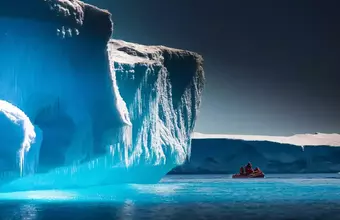
For guests looking for a luxury edge along with access to the north pole, my top tip is Le Commandant Charcot, the world's first and only luxury icebreaker in existence with Polar Class 2 (PC2) classification.
She’s a true pioneer in expedition cruising, much like the explorer Jean-Baptiste Charcot after whom she is named. In September 2024 she became the first vessel to traverse the three Arctic poles – the North Pole of inaccessibility (the point farthest from any landmass), the magnetic, and geographic North Poles – in a single journey.
The Shipowner’s Suite is the largest and most luxurious suite I've seen in Arctic cruising.
Elsewhere on board is a wellness center, heated indoor and outdoor pools, and Michelin-starred gastronomy in Nuna, the only Alain Ducasse restaurant at sea.
The comfort and service levels are extraordinary, yes, but what really stands out for me is the ship’s singular capability of cutting through multiyear ice at such extreme latitudes, being able to venture where no one else can, and the unique experiences and scientific research opportunities that this brings. For those dreaming of reaching the geographic North Pole or rarely visited High Arctic zones, this is undoubtedly the most refined platform available.
The MV Vikingfjord is the little secret I often recommend to travelers who tell me they want a private Arctic experience without the crowds but don't want the cost of chartering their very own ship.
It’s a genuinely small-group vessel with capacity for just 12 passengers, and that scale changes everything: landings are low impact and feel unhurried, wildlife encounters are so much quieter and somehow more personal, and the overall atmosphere is wonderfully relaxed and familial.
With so few, and such likeminded, fellow passengers, it really evokes the camaraderie and true expedition feel of the days of the Heroic Age. You even get access to the bridge with its little lounge area, putting you right at the heart of her operations.
What I appreciate most is how nimble and intimate the experience becomes; you’re not competing with dozens of others to get into Zodiacs or find space on deck, you have the best guide-to-guest ratio (1:6) in the Arctic, and the ship’s small size and 1B-rated ice-strengthened hull means she’s perfect for breaking a path through the ice and exploring places other larger ships simply can’t.
But beyond the logistical advantages, the small-group dynamic of this “micro-cruise” concept really fosters a deeper connection to the polar environment and its wildlife.
Each year, only about 1,000 people make it to the North Pole, which is situated at 90° north latitude.
It’s arduous to get to even on a luxury expedition cruise, so the few people who make it there earn kudos for doing so.
Most cruises leave from Russia or Svalbard and require two weeks at sea. Along the way you may spot polar bears, seals and whales, but for several days the scenery will barely change from flat, white and watery. It’s potentially even a bit dull.
Like with most expedition cruises, your line will entertain you with talks and photography workshops, and you may have the opportunity to kayak or take part in a polar plunge, where you dip beneath the ice in just your trunks or swimming costume to cheers from other passengers.
Everyone cheers again when the ship hits 90° north, after which you’ll walk across the pack ice, pose by the north pole sign and take photos of various signs pointing to cities around the world. Polar bears are unlikely, but expedition teams carry rifles just in case.
Greenland to Svalbard expeditions may call at the Norwegian island of Jan Mayen. Home to the world’s most northerly active volcano, Beerenberg, the isle is 500km from mainland, with no harbours or civilians (there’s a military presence) – making it the ideal nature reserve. Expect a ‘wet landing’ – you’ll have to jump out of your Zodiac inflatable boat – and to spot vulnerable snowy owls, Atlantic puffins and black-legged kittiwake.
Over on the Norwegian mainland, the Arctic Circle passes through Melfjord, halfway up the coast. Itineraries tend to include Svartisen Glacier and the Lofoten Islands, where the sea is Caribbean-clear. If Tromso city is a shock to the system, return to the wild at North Cape, Europe’s most northern point.
Cruises to and from Svalbard pass Bear Island, a nature reserve pockmarked with caves. Fulmars, puffins and gannets circle its shores, but you might also have zero visibility.
On Svalbard itself, you may stop at Hornsund Bay, like the president of The Arctic Club did when he sailed there on his yacht. “We arrived in fog and something nudged our boat,” says Alasdair Flint. “We thought we were being attacked by a polar bear so we got our rifles out, but fortunately it was massive bearded seal.” Sailing clockwise, you may also explore Bellsund; settlements such as Longyearbyen and Ny-Alesund and Lilliehook Glacier. Nordaustlandet Island and the islands near it – Kvitoya, Kong Karls Land, Barents and Edge – are particularly remote, so expect polar bears.
Expedition cruises usually sail from Iceland to east Greenland, or up west Greenland.
West Greenland is milder and has more settlements than the east, making it ideal for Inuit interaction. But hunting practices mean you’re more likely to see wildlife in the east, which explains why I was disappointed with how few whales, seals and walruses I saw in the west. I also didn’t expect so little ice – its shingle landscape often reminded me of a quarry.
However, I sailed through Kangerlussuaq fjord beneath the midnight sun; crawled into Sisimiut’s charming turf house; gazed at the spectacular Unesco-listed Ilulissat Icefjord; and chugged on a fisherman’s boat past icebergs that blew me away. Most itineraries stop at Qeqertarsuaq next, for its sparkling black sand beaches. I called at Niaqornat instead, a hamlet of 25 people. Battling mosquitos, I chatted to locals who I’ve kept in touch with. I also strolled around Upernavik’s gallery, church and cemetery; you can meet Inuit at Kullorsuaq’s fish market and ulu knife artisans in Savissivik, too. Few cruisers make it to Siorapaluk, Greenland’s northernmost native settlement.
If sailing up east Greenland, look out for beluga and bowhead whales. You might explore Nansen Fjord or visit the settlement Ittoqqortoormiit at the mouth of Scoresby Sund, the world’s largest fjord. Gawp at icebergs as tall as department stores, Vikingebugt’s basalt columns and hike the world’s largest national park. Myggbukta’s dilapidated whaling and meteorological station is another highlight, as are King Oskar and Kaiser Franz Josef Fjords.
Most cruises in Alaska explore the sub-Arctic Inside Passage. Few sail into the Arctic Circle, but the ones that do – such as Hurtigruten Expeditions, National Geographic Lindblad Expeditions and Seabourn – sail past Point Barrow. They may also stop at Herschel Island, which has Inuvialuit dwellings and a 19th century whaling station.
Alasdair sailed this stretch in the opposite direction, from Canada’s North West Passage. He says, “I saw a herd of musk oxen on Herschel Island, and got tipped out of my dingy while going ashore for fuel at Barrow Point.
“Alaska’s north coast is fairly dull. There are no mountains, glaciers or icebergs like in Greenland, and you can have days where the horizon is just grey. The water is quite shallow and not particularly well chartered, so big ships can ground there."
Most ships voyage up Baffin Bay or through the North West Passage, which European explorers attempted to navigate between the 15th and 20th centuries.
When sailing up Baffin Island, look out for walruses and narwhals around Broughton Island and bowhead whales in Isabella Bay, while Sam Ford Fjord and Gibbs Fjord have near-vertical 1,500m cliffs. Husky dogs’ melancholic howls signalled my arrival at Pond Inlet, where the indigenous community greeted me with drum dances and throat singing. While some passengers grumbled about the settlement’s bare supermarket shelves, boarded up social housing and women’s shelter, I found it a fascinating insight into Inuit life.
Ice conditions dictate routes inside the Passage, but most lines attempt to visit Dundas Harbour, where I rambled past whale skeletons and abandoned shacks. We held a minute’s silence around explorers’ graves on Beechey Island, which was enveloped in mist. Fog blanketed the migratory birds circling Prince Leopold Island, but when it lifted, I spotted a polar bear and her cub. You may continue to the abandoned trading post Fort Ross; Coningham Bay, where beluga whales attract polar bears; and Cambridge Bay’s Arctic visitor centre.Some lines, such as Hapag-Lloyd Cruises, sail beyond the North West Passage, north of Devon Island. Depending on ice conditions, you might experience Pim Island, Ellesmere Island or Lady Ann Strait.
For the Douro, I’d pick the Scenic Azure. It’s a small ship built specifically for the narrow and winding Douro, carrying up to 96 passengers. It’s the only vessel of its kind in Scenic’s fleet, with a modern, uncluttered design and a compact, easy-to-navigate layout. Despite its small size, there’s a good sun deck with a small vitality pool and a short walking track, and a lounge and bar that work well for a drink before dinner.
Cabins come with butler service, though for me much of the appeal is in exploring ashore. Excursions are included, but you can also go at your own pace using GPS headsets loaded with walking tours – I find this the ideal way to explore Porto’s back streets at my own pace. I also love taking one of the ship’s electric bikes out for a gentle ride along the river.
For the Danube, I’d pick AmaMagna. This vessel is an unusual sight on the Danube: it’s the same length as most river cruise ships, but twice the width. And after a career spent aboard river cruise vessels, I really appreciated the extra space! The extra room allows for larger-than-average cabins – many over 300 square feet, which would be the preserve of top tier suits on other vessels. I also enjoy having more communal areas than you’d find on other vessels. There’s a choice of restaurants, with menus inspired by the regions you pass through to more familiar international dishes, and a generous spa and fitness space.
I absolutely adore the scenery of the Wachau Valley, best enjoyed from the open deck watching terraced vineyards give way to pretty villages and historic towns. It is such a treat to meet with friends at the pop-up bar, or pick a comfortable lounger to watch the world go by. But what I loved best after a busy day of sightseeing was a late afternoon game of pickleball, followed by a dip in the pool with a glass of local wine.
During the day, the atmosphere on board is informal and relaxed; evenings tend to feel a little more dressed-up without being overly stuffy.
For Venice, I’d pick the 126 passenger S.S. La Venezia, which began life as Uniworld’s River Countess but was completely refitted in 2020 for sailing in the Venetian Lagoon. My first impression was the striking interior design, decorated with Murano glass and patterned fabrics giving it a notably ornate and ‘Venetian’ feel. There are three dining venues on board, all serving Italian-inspired dishes, and a mix of public areas for relaxing between excursions.
For me, though, the real appeal is the range of shore excursions and the sense of getting away from the worst of the tourist bustle. We took an evening visit to St Mark's Basilica once the crowds had cleared, with the doors opened just for us. Experiencing this glorious space in the soft evening light, entirely unhurried and peaceful, was truly magical.
While the mega cruises dock at the industrial port on the mainland at Marghera, on the La Venezia you get to experience the Venetian Lagoon in its full glory, visiting lesser-visited islands and docking right in historic Venice.
If you’re into wine, chances are there’s a Europe river cruise for you. It’s a good way to explore the continent’s wine culture: you meander from city to city, calling in at vineyards and wine tastings along the way, and of course – you don’t need to worry about who’s driving!
Wine lovers might initially gravitate towards some of the French big hitters: the bold reds and famous names of the Rhône, the Garonne or the Dordogne. Or perhaps you’d think of the Douro in Portugal, as famous for its port as its hearty reds.
So it might be a surprise to hear me recommend the Rhine and Moselle river valleys as an alternative to the more obvious wine regions. Partially this is just down to personal taste: the rieslings found here are varied, delicate and approachable. Even if you’re not a huge fan of white wine, I’m sure you’ll find something here to your taste.
But I think what really swings it for me is that on these rivers, it’s about much more than simply the wine alone. Only here do you get an excellent wine experience plus the scenic beauty of the Rhine Gorge and the Moselle, the classic storybook towns and the ridiculous density of castles and medieval heritage, all in one package.
So yes, if you’re a red wine person above all else – maybe look to France or the Douro. For everyone else, the below itinerary is my top wine cruise recommendation.
On specifically wine-focused cruises you’ll be hosted by a wine professional and will get a range of excursions with food and wine pairings, curated wine tasting visits, and gentle hikes or cycling trips through the vineyards.
Tiny Darwin Island, at the remote far north of the archipelago, is one of the world’s premier scuba locations and has the densest biomass of sharks anywhere on earth. Rarely visited by standard cruises, these quiet waters teem with whale, Galápagos and silky sharks, hammerheads and more.
The third largest – and youngest – of the Galápagos Islands, volcanically active Fernandina has a unique environment which makes it a haven for thousands of slowly-moving marine iguanas, Galápagos penguins, flightless cormorants and sea lions. This is also the island where you’re most likely to see a volcanic eruption! There is a good 15km hike to Volcan Sierra Negra which departs from Puerto Villamil.
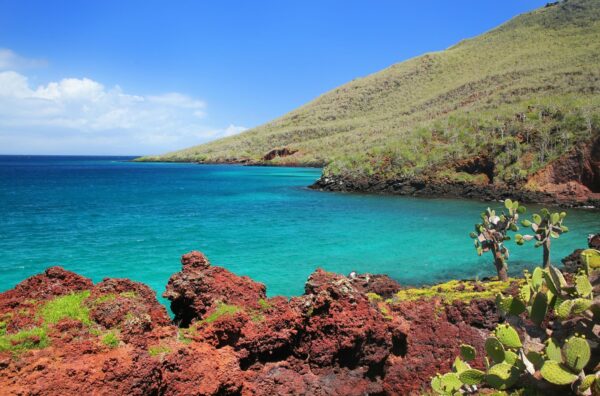
Noted for the unique red colour of its beach and cliffs (from the iron content), Isla Rabida is known for the sizeable population of flamingos that feed on shrimp in its lagoon, snorkelling with sea lions and the large number of bird species that live here.
Genovesa, a remote island in the archipelago’s far north, is visited by longer cruise itineraries and is a favourite for birdwatchers. Also known as Booby Island due to the sheer number of goofy-looking Nazca and red-footed boobies that live here, the island is also home to great frigatebirds, short-eared owls, petrels, Galápagos doves, finches, lava gulls, and many more.
Also here you can visit the tidal pools of Darwin Bay where sea birds hover and marine life flourishes, and climb Prince Philip’s Steps, named for the British royal who visited the island. You’ll see red-footed boobies, Nazca boobies and great frigate birds along the way.
North Seymour is home to one of the island’s first conservation projects. In the 1930s, the crew of Captain Alan Hancock’s ship transferred 72 land iguanas from the nearby Baltra Island to North Seymour in the hopes that the reptiles would fare better without the feral goats competing for food. At last count in 2014, there were 2500 land iguanas on the island.
North Seymour and neighbouring Mosquera Islet are home to a large population of sea lions. Snorkelling here puts you up close and personal with these curious creatures and their young pups.
Also here is a flamingo lagoon on the isolated Bachas Beach, and the largest nesting colony of great frigate birds.
One of the sites used in the movie “Master and Commander,” Bartolomé’s Pinnacle Rock is the closest thing to a Galápagos landmark. The volcanic outcrop formed after lava erupted from an underwater volcano and the iconic formation was used for target practice by US airmen during WWII, adding to its unique shape.
The colourful scenery of the beaches on either side of Pinnacle Rock is contrasted by the barren landscape of Bartolomé’s interior. It’s often compared to the moon or Mars due to the red lava rocks away from the shore.
While here you can climb to the top of the island’s summit, ascending a wooden staircase through the stripped-down landscape. In the shallow waters between the landing point and Pinnacle Rock you can see Galápagos penguins, sea turtles, parrotfish, and small sharks.
On Española, you’ll be greeted by colonies of sea lions and Española lava lizards lounging freely. It’s also known for its nesting sites of Blue-footed and Nazca boobies.
You can hike the Punta Suarez trail to the edge of a cliff overlooking a natural lava blowhole, visit the waved Albatross breeding colony (the world’s population of the species migrates here during April and December). The white sand beach at Gardner Bay is one of the longest in the islands and sea turtles bury their eggs on the beach during mating season between January and March.
After being marooned on Floreana in 1805, Irishman Patrick Watkins became the first known Galápagos resident. Post Office Bay is also here, an informal mail system started in the 1700s by whalers. Mail was left for ships returning home in a barrel by those headed out to sea. The tradition lives on today: you can leave postcards at Post Office Bay for others to pick up and deliver once home.
Also on Floreana is Cormorant Point with two contrasting beaches; a green sand beach caused by olivine crystals and Flour Beach, made from crushed white coral. You can see pink flamingos at the nearby Flamingo Lagoon, watch for Green sea turtles nesting on the sands of Flour Beach. Another highlight is a panga ride to Gardner Inlet for a view of the large caves and rock formations of the island.
Just off the Floreana coast is the Devil’s Crown – a partially submerged, extinct volcano where wildlife thrives. Sea turtles, sea lions and even sharks are commonly seen in and around the crater, while seabirds crowd the outlying cliffs.
Originally named Albemarle Island by pirate Ambrose Cowley, Isabela is one of the youngest and largest of the Galápagos archipelago. It was formed by six volcanoes: Sierra Negra, Wolf, Alcedo, Cerro Azul, Darwin and Ecuador. All are active except Ecuador; Sierra Negra erupted most recently in 2018.
Isabela's famous Los Túneles ('tunnels') are a series of pools sheltered from the sea’s currents with interlacing volcanic bridges spanning the depths. The crystal waters are home to decades-old sea turtles, large sea horses, white-tipped reef sharks and thriving schools of tropical fish.
Also on Isabela you can take a horseback ride to the top of the Sierra Negra Volcano, spot Humpback Whales off the western coast of the island (June to September), see the Galápagos penguins near Tagus Cove – a favourite of pirates and whalers; names of ships dating back to 1836 are carved into the nearby cliff sides.
San Cristobal is the provincial capital of the Galápagos. One of the oldest islands, it was Darwin’s first stop on his historic journey. It’s the home to government and educational institutions. Puerto Baquerizo Moreno acts as the second tourist centre for the islands. Offices of tour agencies, foundations and branches of banks are open during the week.
Kicker Rock, off the west coast of San Cristobal, is one of the best-known sites in the islands to see hammerhead sharks. Hundreds gather in the depths here, while the lion-shaped shadow of Kicker Rock towers above you. Kicker Rock is two hours from San Cristobal and you must be accompanied by a guide.
Also on Cristobal, Cerro Tijeretas is reached by a short hike past the island’s Interpretation Centre. The view offers an amazing view over the bay below and there are trails down to the water and around the area.
Cristobal is also known for its surf, drawing surfers to Punta Carola beach, Tongo Reef, among a few others. There are a few surf clubs and rental shops on the island.
Puerta Ayora, the main town on Santa Cruz island, is the tourist centre of the islands – tour agencies, airline offices, restaurants, banks and shops line the streets. It’s a stop on most tour itineraries and the place to finalise travel plans, find gifts for friends and family, and sample local cuisine.
While here you can hike to Tortuga Bay – considered one of the best beaches in the world and perfect for snorkelling and sea kayaking, hike to lava tubes in the highlands, watch local fishermen compete with sea lions as they land their daily catch, and – a highlight – visit the Charles Darwin Research Station, the original rallying point for scientific and conservation efforts in the islands.
For diving, off the coast of Santa Cruz Island, Gordon Rocks is a submerged volcano where the depths reveal hammerhead sharks, rays, and sea turtles. Currents can be strong and swells in the shallows mean that divers need to stay below 40 ft.
This mighty river running through the heart of Europe has long been romanticized, most famously with the namesake "Blue Danube" waltz by Johann Strauss. But the waterway is not only a European cultural icon, it’s also a key trade route that has played an important role in the continent’s history, from early man to modern times and with all the long and turbulent drama in between.
A cruise on the river offers the very essence of Central Europe: rolling hills and medieval castles, vineyards, bird-lined marshes and cliffs, small river towns and some of Europe’s best known cities.
Cruises on this river typically split into trips on the upper or lower Danube. On the upper Danube, cruises generally sail from Bavaria to Budapest, Hungary, through Austria's scenic Wachau Valley, and include stop-offs at two of Europe’s most important cultural and historic cities, Vienna and Bratislava, Slovakia.
Cruises on the lower Danube take in the dramatic eastern stretch between Budapest and Bucharest, Romania, through Croatia, Serbia and Bulgaria, with Dracula-related stop offs among the many attractions.
While both offer bountiful historic sights and attractions, the main appeal of the upper Danube cruise itinerary is more focused on central European culture, most notably opera and classical music, wine and art, opulent architecture, medieval fortresses and museums. Cruises along the lower Danube offer a fascinating glimpse behind the former Iron Curtain and a taste of life in post-Communist Eastern Europe, while also promising medieval fortresses and Orthodox churches, not to mention the region’s dramatic natural scenery.
With its countless vineyards, stately chateaux and a landscape that has inspired myriad artists throughout the centuries, the Rhône and Saône river region of France is one of the world’s most sought-after river cruising destinations.
The names of the historical French regions that make up the Rhône Basin inspire pure romance: Provence, Burgundy, Auvergne, Rhône-Alps and Languedoc-Roussillon. Here, you find yourself following the footsteps of Van Gogh, Cézanne and Gauguin, inspired by natural beauty and fortified by some of the world’s most incomparable wine and cuisine. Along the way, numerous UNESCO World Heritage Sites vie for attention, from Avignon to Lyon.
Perhaps the most alluring part of a Rhône and Saône river cruise for lovers of good wine is the tremendous winemaking traditions that define this area of Europe. Cruises in the area are sure to include unique experiences: learning about the art of winemaking at the Georges Duboeuf wine village, private wine tastings in Beaujolais and Châteauneuf-du-Pape, wine and cheese tasting in Valance, sampling baked goods and chocolate goodies in Chalon-sur-Saône. It’s certainly a trip to spur an appetite and truly what cruising the Rhône Valley is all about!
Portugal beckons with its pristine landscape, tantalizing cuisine and, of course, port wines, in a setting that seems unchanged throughout the centuries. I adore the terraced vineyards, dramatic rock formations, baroque mansions and historic monasteries that line the banks of this graceful river.
The Iberian Peninsula’s third-longest river – after the Tagus and the Ebro – the Douro river runs 557 miles across the great Castilian region of Spain and on through Castile and Léon, Soria, Burgo, Valladolid, Zamora and Salamanca. The landscape around the river is replete with wheat fields, vineyards and sheep farms.
The UNESCO World Heritage city of Salamanca is a must, as is the 12th-century walled village of Castelo Rodrigo and of course charming Porto, best explored on a walking tour.
The serene Dordogne idles its way through rural southwestern France, passing intricate chateaux, forests and beautiful gardens, some of the country’s prettiest villages and medieval towns.
The Dordogne flows for 300 miles in the southwest region of France and is considered part of the Aquitaine area. Gentle hills – never overly high or steep – flank the river on both sides, with the highest point being Saint Pierre de Frugie at 479 meters. Much of the land – some 100,000 hectares – is devoted to wine-growing, with acreage farther from the river mainly devoted to poultry farming.
Personal highlights are not just the obvious Bordeaux but also La Roque-Gageac, the “cutest town in France,” and historical Beynac and Périgueux.
Cruises along the Rhine boast postcard-perfect views of terraced vineyards and cliff-clinging castles, lending credence to its reputation as one of the world’s most romantic and oft-traveled rivers.
From Amsterdam’s charming canals to the fairytale-esque Black Forest, the river delights lovers of history, wine, culture and cuisine. In the course of a week, river cruises in the region are able to showcase the dramatic Rhine Gorge, legendary Lorelei rock, Holland’s famed windmills and tulip fields, university towns and cosmopolitan cities, medieval castle ruins and esteemed museums.
Flowing for approximately 820 miles, the Rhine River originates at the Rheinwaldhorn Glacier in the Swiss Alps and culminates in Basel, Switzerland – just before which it tumbles over a 75-foot waterfall, the Rheinfall. The majority of the river’s waters pass through Germany, while river cruises along the Rhine will also introduce travellers to the sights and cultures of Liechtenstein, Austria, France and the Netherlands.
Most cruise itineraries focus on the particularly lovely stretch of the Middle Rhine from Bingen to Bonn as it passes through steep gorges (including the Rhine Gorge, at 430 feet deep), along the Rhineland Plateau and in view of the Rhenish Slate Mountains.
With Paris as its highlight, the Seine is made for romantics who seek the serene pleasures of river cruising with the in-depth exploration of the country that this – France’s second-largest river – provides. An inspiration for French impressionism, a setting for world wars and a boon for history lovers, the river is also replete with opportunities to indulge in the country’s fine wine and cuisine.
Extending for more than 480 miles, the Seine originates in wine-producing Burgundy near Dijon and meanders its way lazily through Paris and Normandy to Le Havre, where it joins the English Channel.
My personal highlights on a Seine river cruise include Paris (obvious), the clifftop village of Les Andelys, two-thousand-year-old Rouen, the lovely coastal town of Honfleur, and solemn visits to the Normandy beaches.
At the luxury end you're paying top dollar for lots of space, excellent facilities, top-notch service, and the best guides. Two of my top recommended luxury class yachts are the M/V La Pinta and the M/Y Infinity.
The Infinity is a typical Galápagos luxury class motor yacht with all the usual bells and whistles in this category: spacious decks including a sun deck with a jacuzzi and hot tub, and large comfortable cabins with luxury amenities.
There are two bonuses that make me recommend the Infinity over other luxury yachts. Firstly, it has space for 20 passengers and if there are more than 16 passengers on board, you’ll be divided into two groups each with your own guide which gives you a much more intimate and close experience.
Secondly, the Infinity offers a seven night itinerary B which is one of the most diverse itineraries available, including visits to both the younger western islands and some completely different older islands in the east. Not many itineraries combine both in one cruise.
Another option to consider is the luxury class motor yacht, La Pinta. With a capacity for up to 48 guests La Pinta is significantly larger than most Galápagos cruise ships and generally more stable in rough seas.
It's an all-suite ship with 24 beautiful cabins featuring floor-to-ceiling windows and luxury amenities. The many social areas include a fitness room and a large sun deck with a jacuzzi tub.
There is also a small infirmary with an on-board physician. The ship offers alternative activities like glass-bottom boats, kayaks and stand-up paddleboards. They have a special kids programme for 7-12 year olds.
Your other option at the very top end is one of the many luxury class Galapagos catamarans.
Lots of luxury catamarans have joined the market in recent years, and to be honest I find it hard to recommend one above the others because they’re all truly magnificent ships offering unparalleled experiences.
Three of the best are the M/C Hermes, M/C Sirius and M/C Petrel. They all offer luxury amenities, spacious decks with large cabins and social areas, outstanding guides, superb service and food.
Of course, these cruises also come with the price tag of any luxury tour. The official "rack" rate for a 7-night cruise on these luxury catamarans is about $11,000 per person. If you want to cruise the Galapagos Islands on a luxury catamaran, contact a travel agent and check if there are any special deals first. It is also important to check the specific itinerary of the cruise for your travel date. If you’re spending this much on a luxury cruise, make sure that you also get the best of the islands according to your interests.
The M/V Legend is a 100-passenger first-class Galápagos cruise ship. It’s one of the largest ships in the Galápagos and is significantly larger than the other yachts I normally recommend (but still far from a monster cruise liner.)
I mostly recommend the Legend for families because of the many social areas, a wide range of cabin options, and a great range of kid and family-friendly activities, including glass bottom boats for non-snorkelers.
But what I like most about the Legend is that you can book one of the great value standard or standard plus cabins but enjoy the same first class service on board.
A ship this size has loads of different social areas, including a kids' playroom, large outdoor areas with a swimming pool and two hot tubs, a small gym and a souvenir shop. Excursions and landings are organised in small groups of 16 travellers per guide, with groups organised by nationality and language. There are English and Spanish speaking naturalist guides on board, plus French and German-speaking guides if there’s sufficient demand.
The Legend is one of few Galapagos cruises that accepts babies on board and always has a physician on board.
In first class category you're paying extra for two big things: additional space on board and the quality of guides and excursions.
My top recommended first class Galapagos cruises are the M/C Anahi and the M/Y Beluga.
I always get good feedback from passengers on the M/C Anahi, a great value first class catamaran. Due to their design, catamarans are generally more stable than yachts, making them a good option if you’re worried about seasickness.
The Anahi isn’t as modern or big as the new luxury catamarans but the ship has been cruising the Galapagos Islands for many years, it’s well maintained and regularly renovated. The operations run smoothly, the crews are very experienced and the guides are very knowledgeable.
And the Anahi's bonus: there is a jacuzzi hot tub on the upper deck.
Another option is the M/Y Beluga. Built in the 60s (but renovated many times since!) this ship is not as modern as the other first class cruises but I like its aesthetic and homely atmosphere, with traditional wooden details and great service on board.
The Beluga is a typical first class motor yacht with eight good cabins with space for up to 16 passengers. At this price point the main benefit is extra space in the cabins, dining and communal areas. The only downside for me is that only three cabins have large windows, so you’ll need to book in advance if you want to guarantee a good view.
The Beluga offers some excellent five and seven night itineraries, which can be combined if you want a longer cruise.
In the tourist superior class you're paying mid-range rates for mid-range experience. You'll have more space and fewer passengers than an economy class ship. Roughly equivalent to a three star hotel. Often you'll find older first class ships find themselves in this category as newer first class yachts come onto the market.
Until recently I would have described the M/Y Monserrat as a first class Galápagos cruise ship, but as newer and fancier first class yachts have joined the market, I now prefer to describe the Monserrat as a tourist superior class option. Therefore it’s an excellent value, high quality cruise in this mid-range price bracket, and one I often recommend.
From 2025, the Monserrat has 10 comfortable cabins for up to 16 passengers, good on-board service, and even free wifi.
It offers a great selection of itineraries, ranging from a whopping 15 day cruise to all the islands, down to some good short (three and four night) itineraries which can be combined together to visit both the western and eastern islands.
The M/Y Bonita is another former first class Galápagos cruise ship that I’ve now relegated to tourist superior class, giving it great value for money. This is a lovely yacht with ten comfortable cabins and space for 16 passengers, spacious social areas and free internet access.
The Bonita yacht has convenient official "rack" rates and sometimes special discounts or offers including the flight ticket even months ahead of departures. There are no extra charges for upper deck cabins and rooms are distributed in a "first come first serve" manner. Because of this flexibility, I often recommend the Bonita to travellers who want to book their cruise well ahead of time without breaking the bank.
I find the six night itinerary A to the western islands is a great option for visitors who want to explore this region in depth but can't afford a seven night cruise.
True economy class boats are an endangered species in the Galapagos as operators chase more lucrative higher spending markets.
The M/Y Golondrina is one of the remaining economy / tourist class yachts, and I'd say it's the best Galápagos cruise ship for more budget-conscious visitors.
Cheaper cruises usually cut costs with shorter itineraries to only the inner islands: the Golondrina is the best and cheapest budget option with itineraries to the outer islands. (I also recommend the Aida Maria which may visit all islands, but is usually more expensive.)
The four night itinerary “B” to all the key points on the western islands is especially popular.
The yacht is designed in the traditional style. It’s small and basic, but has everything you’d need: AC, private bathrooms, a bar, and good meals freshly prepared by the on-board chef.
It carries just 16 passengers, so you’ll get to know your fellow passengers, and operations and guides are usually pretty good.
For those who care about tourism income staying in the local country, the Golondrina is owned and operated by the Ecuadorean-based company, Tierra Verde.
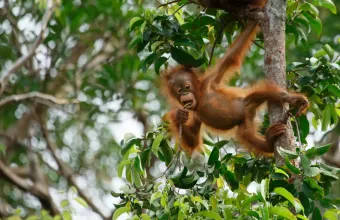
The Kahayan River, immediately east of Sebangu National Park, is a real hidden gem which doesn't feature highly on most 'mainstream' orangutan-spotting itineraries. The main reason I recommend the Kahayan River to almost anyone who visits Indonesian Borneo is because it's here that you can combine wildlife spotting with real and meaningful cultural interactions with the indigenous Dayak people which is, I believe, key to ensuring the long-term survival of both the orangutans and the people who live here.
You access the Kahayan River from the town of Palangkaraya, which is close to the forested island of Pulau Kaja. This is a pre-release habitat for rescued orangutans managed by the Borneo Orangutan Survival Foundation, and it's possible to spot orangutans from the river. Downstream from Palangkaraya are Dayak villages of Bukit Rawi, Sigi Tumbang Nusa and Pilang, where you can learn about indigenous religion, cultures and traditional livelihoods. At night the captain will simply find a sheltered location on the bank to moor the boat – it's a true expedition!
If you're solely interested in tracking orangutans, the Kahayan River area might not be for you (although it can be easily combined with a visit to nearby Sebangu National Park). However, if you're remotely interested in traditional culture and the interaction of cultural preservation and wildlife conservation, I can't recommend this area highly enough.
“One of the natural wonders of the world”, according to the UK’s Orangutan Foundation, Taman Nasional (National Park) Tanjung Puting is home to the world's largest population of wild orangutans and represents their best hope for survival.
It was at Tanjung Puting in 1971 that leading orangutan authority Dr Biruté Galdikas established the Camp Leakey research station — an instrumental step in bringing the plight of the park’s most famous resident to worldwide attention.
Set amid the largest swathe of coastal tropical heath and peat swamp forest, which used to cover much of southern Borneo, Tanjung Puting started out as a game reserve in 1935 before becoming a National Park in 1982.
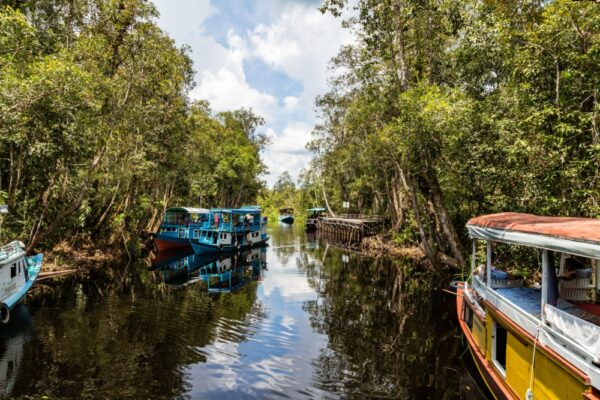
The best way to experience the wonders of Tanjung Puting is on a traditional klotok (houseboat) puttering gently along Sungai Sekonyer as you search for pot-bellied macaques, hornbills and the odd crocodile.
Starting from the Kumai river port in the central Kalimantan city of Pangkalan Bun, your guides will typically stop at three main feeding stations within the park, where you will get to experience semi-wild orangutans during feeding sessions. The best option for this is at Tanjung Harapan, but you’ll also stop at Pondok Tangui. Your final destination will be Camp Leakey, a 4-4 ½ hour journey upriver.
From the docking point, be prepared for a 45-minute walk to the first feeding platform at Camp Leakey, on a flat and well-maintained path. Here, as well as orangutans, you will see Bornean bearded pigs, gibbons and mangrove-loving proboscis. Camp Leakey is your best chance to see orangutans — most were released around here and stay close to the site. In general, orangutans around Camp Leakey are the most relaxed around humans. Look out for Tom, the camp’s alpha male (but if you do see him, be careful not to engage in a staring match).
Once feeding time is over, you can explore the camp’s excellent information centre. Tanjung Puting offers plenty of other activities including birding, hiking and wildlife tours — as well as cultural trips to remote villages.
Ultramarine
Le Commandant Charcot
MV Vikingfjord
The North Pole
Norway & Svalbard
Greenland
Alaskan Arctic
Arctic Canada and the North West Passage
Scenic Azure
AmaMagna
S.S. La Venezia
The best rivers for wine cruises
Scuba on Darwin Island
Iguanas and penguins on Fernandina
Flamingoes and snorkelling on Isla Rabida
Isla Genovesa for birdwatching
North Seymour for iguanas
Pinnacle Rock on Isla Bartolomé
Sea lions, lizards & boobies on Isla Española
Isla Floreana for turtles
Isla Isabela for lava tunnels
Sharks & surf on San Cristobal
Get your bearings on Isla Santa Cruz
The Danube
The Rhône & Saône
The Douro
The Dordogne
The Rhine
The Seine
Best luxury Galapagos cruises
M/V La Pinta, M/Y Infinity
Best Galapagos cruise for kids and families
M/V Galapagos Legend
Best first-class Galapagos cruises
M/C Anahi & M/Y Beluga
Best mid-range Galapagos cruises
M/Y Monserrat & M/Y Bonita
Best economy class Galapagos cruise
M/Y Golondrina
Indigenous cultures & conservation on the Kahayan River
Fran Golden is a well-known cruise writer whose work appears in numerous magazines, newspapers and websites including USA Today, Virtuoso Life, Porthole, World of Cruising, Sherman's Cruise and Cruise Business Review. She is also the author of several cruise travel books including Frommer's EasyGuide to River Cruising. She's personally cruised on more than 150 ocean and river ships.
Jon is a travel writer and guidebook researcher based in Quito, Ecuador. He has authored the Moon guides to Ecuador and the Galapagos Islands and contributes to Delta Sky Magazine and the Happy Gringo Travel website.
Sarah is an expedition cruise expert who has written for Condé Nast Traveller,National Geographic Traveller, Adventure.com, the FT and The Independent. She is also the former editor of World of Cruising and Wanderlust Magazine, deputy of Time Out Abu Dhabi and Where London and author of London Almanac (2010) and Culture Smart! The Essential Guide to British Customs & Culture (2024).
Journalist-travel writer and photographer, Tamara Thiessen is an expert on Borneo with her 4th edition Bradt Travel Guide to the island due in 2020. France-Australia based, she works for newspapers, travel & leisure publications and in-flight magazines worldwide and is the author of several books
Spring is good for fewer tourists in the main hotspots, and potentially lower rates. March to April is tulip season in the Netherlands, which is a delight. On the other hand water levels are unpredictable, with an elevated chance of disruption.
Summer is peak season across Europe and is a good time for wine focused cruises in the Rhine, Moselle, and Bordeaux regions. You might think it’s best to avoid the busy cities in summer but actually being on a cruise helps you bypass overbooked hotels and the worst of the crowds.
Autumn (fall) is good for fewer crowds in the cities and is also the grape harvest season in wine regions. If you’re lucky the weather will still be comfortable. This is my favourite time for a Europe river cruise.
And finally, I have enjoyed several Rhine river cruises over Christmas. The atmosphere is magical, with German cities and towns such as Cologne, Koblenz, and Rudesheim pulling out all the stops with stalls and displays.
Note that most river cruise vessels don’t sail in January and February, because vessel maintenance and preparation take place for the following season.
I'm looking for a classical music focused cruise in Europe, especially baroque and/or Renaissance. What would you suggest?
Answered by: Edwina Lonsdale
AmaWaterways has two sailings with a baroque musical theme available in 2026, departing on 1 July and 8 July. Each is a 7-night trip on the Danube, starting and finishing in Budapest aboard AmaReina.
In 2027, there are three sailings on the "Celebration of Music – Best of the Danube" itinerary, although these don't have a specific baroque or Renaissance focus:
7 July 2027 with Stephen Jarvia, Music Director of the Dearborn Symphony
18 August 2027 with Andreas Delfs, Music Director of the Rochester Philharmonic Orchestra, and his wife and music partner Amy Delfs
22 September 2027 with David Rhyne, Director of Music at St Michael Lutheran Church in Greenville, South Carolina
In-depth nature & wildlife tours in outstanding destinations
1
Your trip
2
Complete your request
3
Meet your specialist
Your details are safe and will not be used for any other purpose. By using this service you agree for us to share your details with your chosen tour operator according to our Privacy Policy.
1Your trip
2Complete your request
3Meet your specialist
Find a Cruise & Sailing specialist
Tell us about your trip and we'll find your match
We'll connect you directly with the experts.
Connect with Gaye, Martha Cohen, Ruth Franklin and 3 other Cruise & Sailing specialists.
We'll connect you directly with the experts.
Connect with Gaye, Martha Cohen, Ruth Franklin and 3 other Cruise & Sailing specialists.